
BICO's week: a rising price and negative funding
BICOUSDT rose 43.92% over August 20–26 as all 21 funding settlements stayed negative. A closer look at the pullback, late rally, and trading volume.
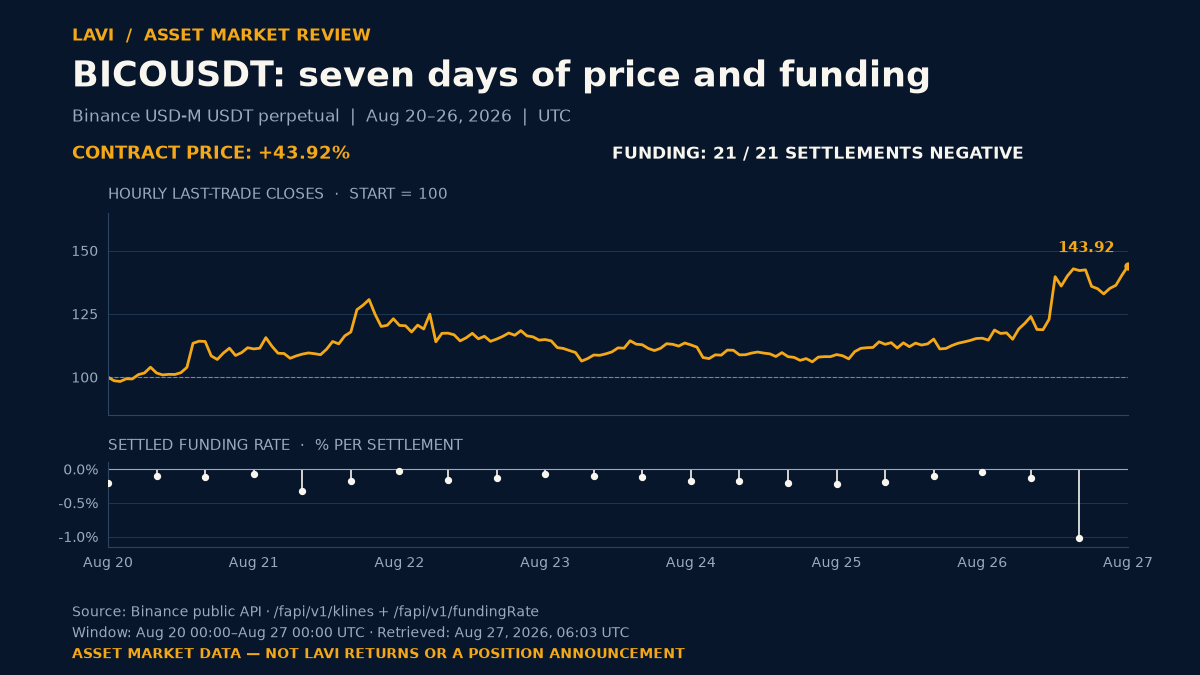
BICOUSDT ended August 20–26 up 43.92% on Binance, but the rally came with a striking contrast: all 21 funding settlements were negative. The contract climbed while shorts paid longs to keep positions open across those settlements.
The week unfolded in three stages—an early advance, three consecutive down days, and a sharp recovery. More than half of its trading volume arrived in the final session. Together, price, activity, and funding describe a market that changed pace dramatically within seven days.
The market behind BICO
Biconomy develops infrastructure that helps applications coordinate blockchain transactions and simplify execution. BICO staking and delegation form part of its network, as described in the project documentation and token portal.
The BICOUSDT perpetual on Binance is a separate trading market: a USDT-margined contract with its own order book and funding payments. Its price reflects trading in that contract, rather than staking income or a direct measure of Biconomy adoption.
Three down days before the final surge
The contract rose from a starting reference of 0.01703 USDT to a final hourly close of 0.02451 USDT. The window covers August 20 at 00:00 UTC through August 27 at 00:00 UTC; the reference is the immediately preceding hourly close.
August 20 and 21 delivered gains of 11.16% and 8.35%. The next three days reversed part of that advance, falling 4.63%, 1.84%, and 3.39%. A 5.93% recovery on August 25 was followed by a 24.73% jump on August 26.
That final session gave the week much of its momentum. The 43.92% overall gain came through a retreat and recovery, not a steady climb.
Prices traded between 0.01545 and 0.02728 USDT during the window. Those extremes include intrahour highs and lows; the chart follows hourly closing prices. Binance hourly candles.
Half the week's turnover in one day
Trading volume reached approximately 194.78 million USDT across the seven days. August 26 contributed about 101.33 million USDT, or 52% of the total. August 24, by comparison, recorded roughly 6.60 million USDT.
The late rally coincided with a pronounced increase in trading activity. Turnover measures completed trades, including repeated buying and selling; it is not a measure of fresh money entering the market.
For execution, a busy session and a deep order book are different things. Spreads and available size determine the prices an order can reach. High turnover can coexist with fast price changes and uneven fills, so volume alone cannot establish better liquidity.
Rising prices, negative funding
All 21 funding settlements were negative, ranging from −1.020792% to −0.023603% per settlement. The recorded settlements were approximately eight hours apart. Binance funding history.
With negative funding, shorts pay longs. The payment depends on the position's value and whether it remains open at settlement; the rate is applied to position value, not account equity. How Binance funding works.
For a short held through both a price increase and a negative funding settlement, the two effects work in the same unfavorable direction: the contract becomes more expensive to buy back, while funding adds a payment. A long held at settlement receives funding, but its overall result still depends on entry and exit prices, size, and fees.
Negative funding was therefore no obstacle to this week's rise. Funding describes the payment between the two sides of a perpetual market, not the direction its price must take next.
A changing market, a consistent process
BICO moved from an early rally to a multi-day decline and then a much busier final session. Such changes affect the environment in which a futures strategy executes, even when its decision rules stay the same.
Lavi's systematic approach separates those repeatable rules from the changing conditions around them. Price movement, liquidity, fees, and funding all shape the path from a trading decision to its eventual result. The Lavi methodology explains how research becomes a live process.
The week in perspective
A 43.92% rise, three intervening down days, and 21 negative funding settlements made this a more complex week than the ending price suggests. The late concentration of turnover adds another important detail: trading activity was far from evenly spread.
Market data: Binance BICOUSDT USDT-margined perpetual, August 20–26, 2026, UTC. The chart uses 168 completed hourly candles plus the starting reference. Retrieved August 27, 2026, at 06:03 UTC. Contract-price changes are separate from Lavi portfolio returns.